


The Threatened Old Growth Forest Dependent Species of the Carmanah and Walbran Valleys
Author: Peter Cressey for the Friends of Carmanah Walbran
The Carmanah Walbran Provincial Park is located on Southern Vancouver Island within the Traditional Territory of the Pacheedaht and Dididaht First Nations. The park contains the whole 11,000 hectares of the Carmanah Valley and 5,500 hectares of the lower Walbran Valley
Since 2012 the Friends of Carmanah Walbran has been working to increase the area of protected Old Growth Forest in the Walbran watershed. We have advocated a 1,500 hectares area along the park boundary called the Central Walbran. The Upper Walbran Valleys has become highly fragmented by clearcuts and is still in the process of being logged.
To enable access and bring public attention to this remote area we instigated a project that has built and maintained trails, boardwalks, stairs, signage, out-houses and a visitor centre. There is around 3 kms of boardwalk trail over the delicate forest soils, helping to mitigate the impact of the increasing number of visitors.
The time spent in this forest has given us the opportunity to document the area's unique species. We have held annual Bio and Myco blitzs, flora, fauna and fungi surveys with the help of many knowledgeable and passionate people. Over the years this has created a connected and engaged community working for the forest’s protection. The iNat project for this area has now collected over 750 species. This has led to a temporary deferral on logging in the Central Walbran in 2021 and has gone towards its recent designation as part of a Key Biodiversity Area (KBA) in 2026.
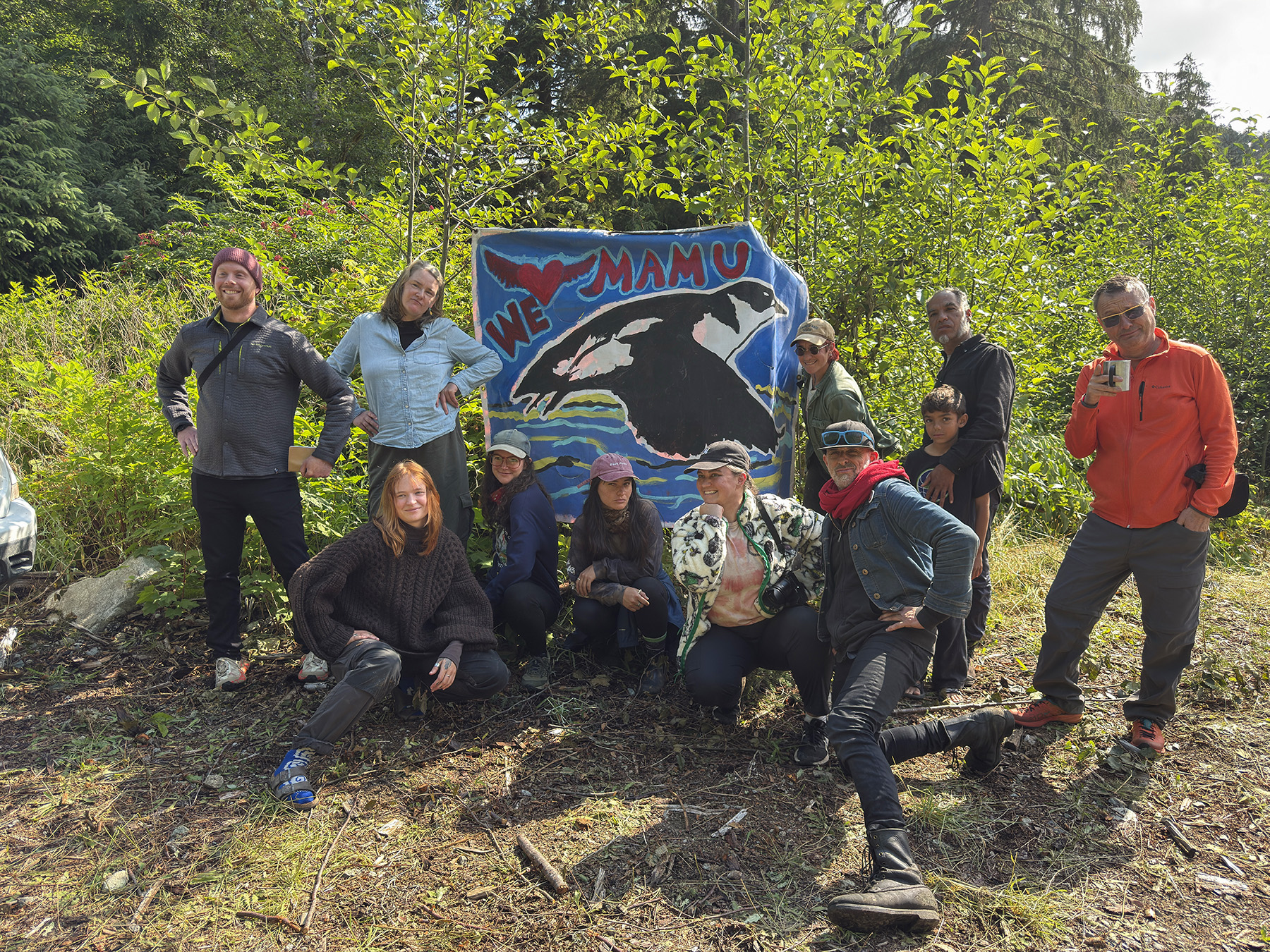
This year we have again organized with the ‘Old Growth Birders and Bio-Blitzers’ a Marbled Murrelet (MaMu) educational event. This weekend event is called ‘MaMu Day’ and is held on July 12th every year at the very height of the birds nesting season.
The MaMu is a small elusive seabird (Brachyramphus marmoratus) that relies on coastal Old Growth forests, the forest being its nesting grounds. The birds make use of the shelter and safety offered by the trees to lay their single egg on the thick moss mats that accumulate on their wide branches. The chick once fledged must make its first flight from the tree branch to its waiting parents in the ocean, a flight that can be up to 50 kms in distance.
The bird was designated in 2003 by the Canadian government Committee on the Status of Wildlife in Canada (COSEWIC) as a threatened species. The primary threat is the ongoing loss of coastal Old Growth forests to industrial logging and nest predation which has been increased by forest fragmentation and edge habitats frequented by their Corvid predators like Crows, Ravens and Stellar's Jays. As these seabirds spend most of their time diving for seafood in coastal waters, they are also impacted by fisheries by-catch, marine food depletion, oil spills and other pollution. Depending on the nesting quality of the forest trees, MaMu requires 10-50 hectares of intact old growth forest per pair (Dr Alan Burger).
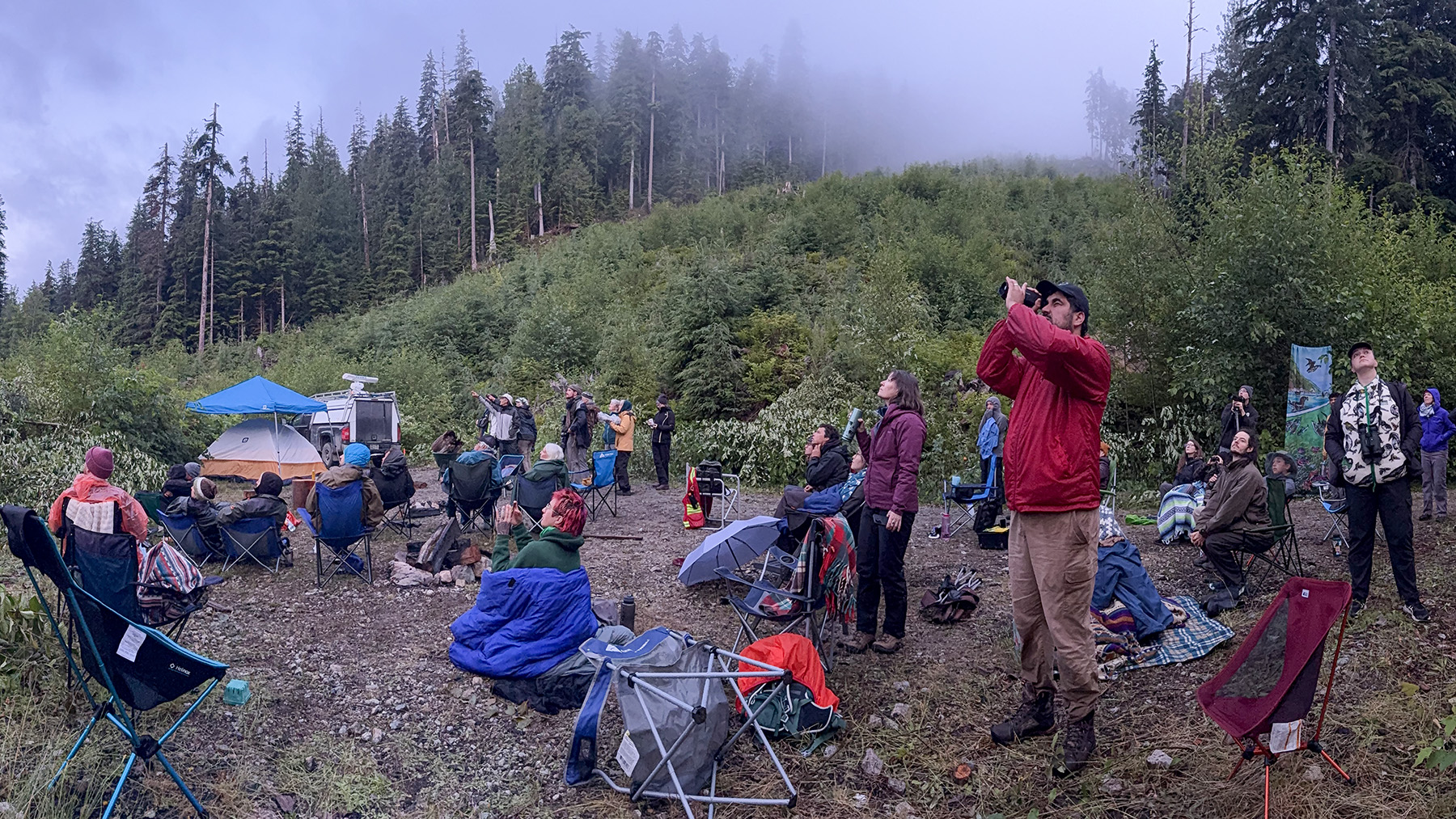
On the Saturday evening of the weekends event the 51 attendees took part in a learning circle led by Dr. Royann Petrell, with various other MaMu experts and birders. Then after camping overnight, we woke up for an early start at predawn on Sunday morning. This is the best time to hear and observe the birds as they use the low light and misty conditions to avoid predators as they fly from the ocean into their nesting grounds.
This year we are on the northern edge of the Walbran side of the park. The event was originally planned to be held in Central Walbran, but in March this year a logging company gate with 24hr security was installed on the only access road. Repeated requests to allow us access for this bird watching event were denied. The exclusion from this area is concerning with the current logging deferral still only temporary.
As we gathered in the grey light of the early morning there was heavy mist drifting amongst the trees in the park. Conditions like this are ideal for hearing MaMu, the old loggers name for them being ‘fog larks’, as in the mist they will call more frequently to each other. We could hear their seabird like ‘keer-keer-keer’ calls first, then dozens of murrelets appeared at tree top height moving fast across a clearcut on the edge of the park.
They are roughly pigeon sized birds; their wings distinctively paddle shaped. The wings are dual purpose shaped for both swimming underwater to depths of 30 m to catch small fish and for flights of up to 30-50 kilometres inland to reach their hatchlings.
Bernard Schroeder, a long-time bird researcher specializing in endangered species, was here with a state-of-the-art radar antenna detecting the flight speeds (80-90 km/ hr.), numbers and locations of murrelets travelling up the watershed.
Peer-reviewed radar counts from 1996 to 2018 established a steady 2.4% annual decrease coast-wide, with the steepest declines concentrated in the heaviest logged watersheds. Another study focused on sea-counts off Pacific Rim National Park Reserve showed higher annual declines of -3.1% per year amounting to an alarming loss of over 50% of the local population over the past 20 years. BC Conservation Data Center gives a 2021 BC population estimate of 74,300 down from 99,100 in 2007 and predicts a short-term decline of 30-70% and a long-term decline of 50-80%. These population declines raise serious concerns around the species survival, with reduced genetic diversity less able to cope with the threats of climate change, warming oceans and bird flu.
As the morning progressed, we watched the spectacle of the birds’ flight, cameras clicked and hands pointed as the birds circled and flew past, everyone now standing, the surprise and awe in people’s voices comparable to a fireworks display.
Amongst the many people who were watching the murrelets was a group of artists whose experience here will inspire their art and evolve into a future art event, perhaps in the local communities of Lake Cowichan or Port Renfrew, and in the capital, Victoria.
The last call was heard at around 6.30am. In the quiet after we stayed and talked about this experience of this rare and endangered bird and what we can do to ensure that this ancient forest and the incredible species that rely on them can continue.
If you wish to support the protection of the critical Marbled Murrelet Old Growth Forest habitat, please email your letters of support to the Minister of Environment and Parks, Tamara Davidson, at ENV.Minister@gov.bc.ca
For more information, email friendsofcarmanahwalbran@gmail.com